
01 / BUYER LENS
Trim Code risk needs proof.
On a modern XPI injector, the trim code is not decorative text.
TRIM CODE / BUYER DOSSIER
On a modern XPI injector, the trim code is not decorative text. It is part of the injector’s usable identity, and buyers who treat it as optional usually discover the problem at the worst point in the process: after the quote, during installation, or in the first round of troubleshooting.

COVER SHEET
Best for workshop / qa / fleet. Read it through Trim code / Coding / Commissioning.
01 / BUYER LENS
On a modern XPI injector, the trim code is not decorative text.
02 / WHAT TO CHECK
Trim code / Coding / Commissioning
03 / DECISION CUE
Code integrity belongs in usable identity, not in an afterthought.
OPENING BRIEF
A surprising number of aftermarket injector problems start with a part number that looks right.
The box label matches. The engine family sounds right. The supplier says the injector is “for Scania XPI” or “for Cummins XPI.” Then the workshop asks the question that actually matters: where is the trim code, and does it belong to this injector?
That question matters because XPI is not an old mechanical fuel system where a buyer can think in purely physical terms. Cummins describes XPI as a high-pressure common-rail system for mid-range and heavy-duty applications, with pressures up to 2,600 bar and a control strategy built around precise injection events. Scania likewise positions XPI as “Extra High Pressure Injection” under EMS control on its industrial engines. In that environment, injector individuality is not a side note. It is part of how the system is managed.
The cleanest way to say it is this: for modern XPI aftermarket supply, trim-code integrity is not optional because the code is part of the injector’s service identity, not just a marking on the body.
That does not mean every XPI application uses the same coding workflow. It does not mean every engine family handles injector adaptation in an identical way. It means something more practical: if the injector family expects injector-specific characteristic data, the buyer has to know whether that data is present, legible, matched to the unit, and usable at installation.
BUYER HANDOFF
Use these articles to keep calibration, coding, and install-readiness questions attached to the right injector lane.
Query definition
On a modern XPI injector, the trim code is not decorative text. It is part of the injector’s usable identity, and buyers who treat it as optional usually discover the problem at the worst point in the process: after the quote, during installation, or in the first round of troubleshooting.
Why it matters commercially
Coding gaps turn a seemingly correct injector into an installation failure, warranty dispute, or delayed approval loop.
How to verify
Common mistakes
BUYER HANDOFF
Review the coding-sensitive application lane, then the product page, and carry the coding requirements into RFQ.
application
Use the application hub to confirm the engine-family lane before the RFQ leaves the desk.
OPEN APPLICATION HUBproduct
Open the product/category path that turns the technical question into a real shortlist.
REVIEW PRODUCT PATHrfq
Carry the verified identifiers into the stable RFQ workflow instead of a support-only page.
START RFQTRIM CODE EVIDENCE BOARD
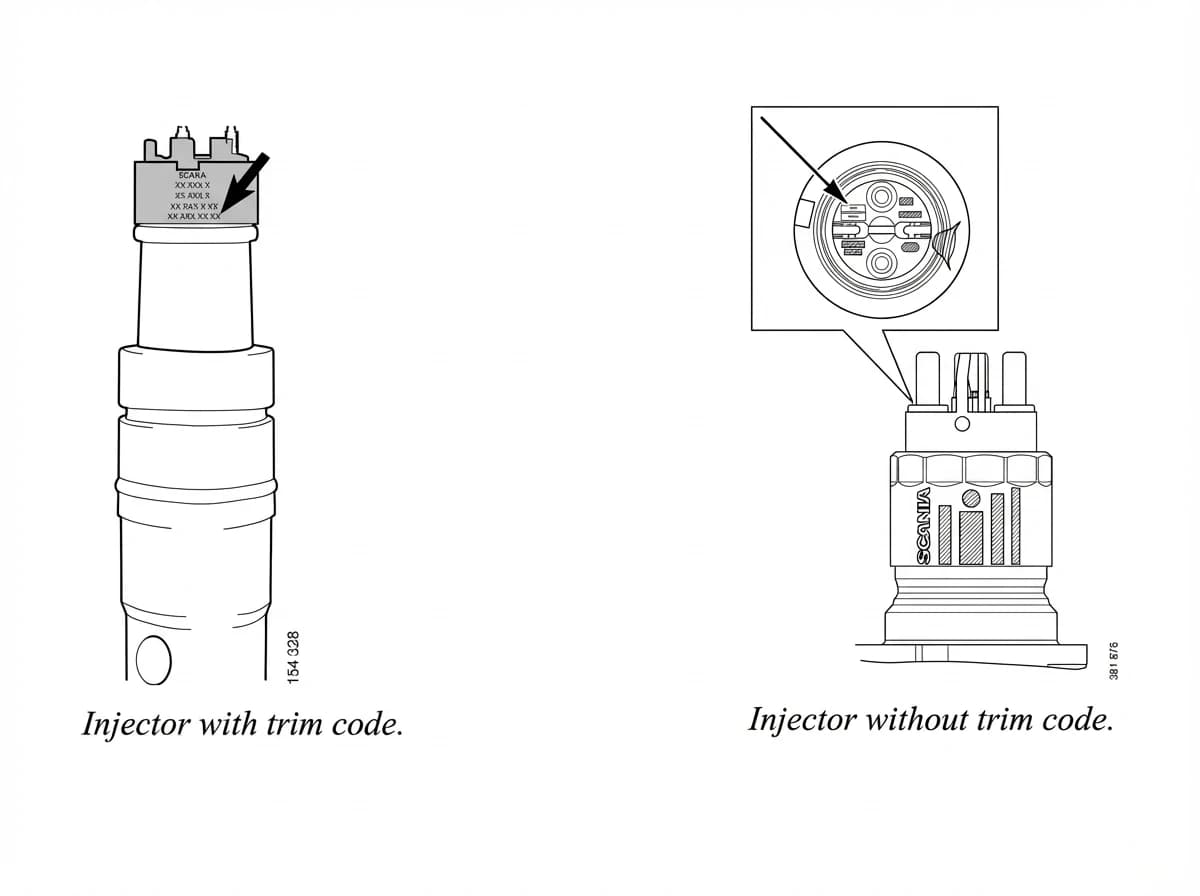
Lead with one dossier image, two support views, and one buyer matrix built around Trim code / Coding / Commissioning.


COVERAGE MATRIX
Trim code / Coding / Commissioning
Code integrity belongs in usable identity, not in an afterthought.
TRIM CODE
In buyer language, a trim code is the injector’s individual calibration identity.
Modern electronically controlled common-rail injectors are not treated as perfectly identical pieces. Small injector-to-injector differences exist. Peer-reviewed common-rail research notes that production variability between injectors affects delivered fuel quantity, and that injector-specific codes are used in practice to reduce the effect of that variability. Bosch’s own diesel test-equipment literature reflects the same reality from the service side: modern common-rail injector test benches support injector coding as part of test and adjustment workflows.
Different platforms use different names. In the wider diesel world you will see terms such as trim code, adjustment code, correction code, IMA, IQA, or injector characteristic data. Buyers do not need to master every acronym. They only need to understand the commercial consequence: the injector is not fully qualified by hardware fit alone.
If a supplier can only tell you the part number but cannot tell you the code status, you do not yet know enough.
CODE
XPI systems are designed for very high pressures and fine control of injection events. Cummins explicitly highlights multiple-injection capability, while Scania’s XPI material ties the system to engine-management control and emissions performance. That level of control is one reason XPI systems deliver the combustion, economy, and emissions outcomes they do. It is also why injector-specific variation matters more than buyers sometimes assume.
Cummins’ public material on fuel quality makes the broader precision point clearly. High-pressure common-rail component tolerances have tightened dramatically, and contamination or wear affects performance and durability much faster than many buyers expect. The same “precision system” logic applies to injector characterization. When the system is built around tight tolerances and electronically controlled delivery, the supporting data matters.
That is also why workshops no longer judge injectors only by whether they can be bolted in. Serious workshops now ask whether the injector carries usable code data, whether that code has been recorded before shipment, and what the installation workflow expects on the specific platform.
FITMENT
A lot of weak buying decisions come from giving the code magical properties it does not have, or dismissing it entirely.
A trim code gives the control system or service workflow injector-specific information used to handle small differences between injectors. In practical terms, it is one of the tools used to keep fuel delivery behavior where the system expects it to be.
A trim code does not turn the wrong injector into the right injector.
It does not replace part-number confirmation, engine-side fitment review, or installation cleanliness.
It does not mean all injectors with the same base number are interchangeable without further checking.
The right mindset is stricter: part number confirms what the injector is supposed to be; code integrity helps confirm whether that individual injector is ready to be used as intended.
CODE
The code problem is rarely dramatic at the time of purchase. It becomes expensive later.
If the code is unreadable, damaged, omitted from the listing, or never recorded, the buyer may not discover the gap until the injector reaches the bench or the engine. At that point the order is no longer a sourcing problem. It is downtime.
A wrong code can be as commercially damaging as a wrong part number because it sends the installation process into doubt. Depending on platform logic, the result may be a rejected entry, extra workshop time, or avoidable diagnostic confusion.
This is one of the most serious aftermarket red flags. Reusing a code from another injector, or copying one code across multiple units in a set, defeats the whole reason injector-specific characterization exists.
A code on the injector body is useful. A code recorded against a traceable unit ID is far more useful. Without that link, the supplier cannot prove which code left with which injector.
This is the outsider mistake. Some systems require explicit code entry. Some include additional reset or adaptation logic. Some later variants or different injector families handle setup differently. Buyers who flatten all of that into “coded” versus “not coded” usually create avoidable back-and-forth between procurement, workshop, and supplier.
FITMENT
For a workshop, the risk is obvious: extra fitting time, rework, delayed return to service, and messy diagnostics.
For procurement, the risk is slower but just as real:
That is why trim-code integrity belongs in supplier qualification, not just in installation notes.
BUYER
| Checkpoint | Why it matters |
|---|---|
| Is the trim code present and legible? | If not, the injector may already be difficult to commission or support. |
| Is the code tied to the specific injector being quoted? | A loose code list is not the same as unit-level traceability. |
| If multiple injectors are supplied, are the units individually identified? | Set-level confusion is common when documentation is weak. |
| Has the supplier recorded the code before shipment? | Useful for receiving checks, install support, and dispute handling. |
| What installation workflow is expected for this application? | XPI service logic is not identical across every platform. |
| What happens if the workshop reports a code-entry issue? | A serious supplier has an escalation path, not a shrug. |
A buyer does not need every answer in engineering depth. But a buyer should be able to tell, very quickly, whether the supplier understands the question.
BUYER
Be cautious when the offer sounds like this:
That is not proof-led aftermarket language. It is risk-transfer language.
TRIM CODE
Trim codes matter on their own, but buyers should place them inside a wider qualification model.
A strong XPI injector offer usually combines:
That is why Dieselink’s trust narrative — trim-code integrity, fitment-first quoting, verified injectors, bench-test evidence, QR traceability, and cleanliness control — makes commercial sense when read together. No single element carries the whole burden. The point is that a serious supplier treats injector identity as something to be proved, not assumed.
BOTTOM LINE
On XPI injectors, the trim code is not an accessory to the part. It is part of the part’s usable identity.
A buyer who ignores that may still receive something that looks correct on the shelf. But the real aftermarket test begins later: during quote validation, receiving inspection, installation, and the first support call. That is exactly where weak code discipline gets expensive.
The best buyers do not wait for that moment. They ask about code integrity before the order is placed, and they treat the answer as part of supplier qualification.
TAKEAWAYS
A trim code is injector-specific characteristic data used in modern electronically controlled injector workflows; it is not decorative text.
On XPI-era common rail systems, hardware fit alone is not enough. Code status is part of the injector’s service identity.
Missing, wrong, reused, or undocumented codes create commissioning, diagnostic, and supplier-support risk.
Part number, fitment review, and trim-code integrity do different jobs. None replaces the others.
The right buyer question is not “Does it have a code?” but “Is the code legible, traceable, and usable for this application?”
FAQ
In practical terms, it is the injector’s individual calibration or characteristic identifier. It exists because modern electronically controlled injectors are not treated as perfectly identical pieces.
Yes. The base part number tells you the injector family or application range. The trim code identifies the individual injector’s characteristic data within that family.
No. Fitment still has to be confirmed through the right identifiers for the engine and application. The trim code supports injector-specific readiness; it does not prove broad application fit on its own.
That should trigger a more careful supplier conversation, not a guess. The replacement injector still needs its own intact, usable code status and application review.
No. Platform logic and service workflows vary. That is one reason buyers should ask about code status and expected installation steps before purchase rather than assuming every XPI job follows one universal script.
NEXT IN THE SYSTEM

fitment
The fastest injector quote is not the shortest inquiry. It is the inquiry built on the right identifiers. For XPI applications, different identifiers answer different fitment questions, and no single number should be treated as a universal shortcut.

evidence
The aftermarket says “tested” far more often than it proves testing. For XPI injectors, serious buyers should expect evidence that can be tied to the actual unit or shipment: identity, fitment review, code status where relevant, test records, traceability, protected handling, and documents that agree with one another.

supply paths
XPI buyers often inherit lazy category language. “New,” “reman,” and “white-box” are used as if they automatically settle quality. They do not. Each category carries a different proof burden, a different risk profile, and a different fit for procurement, workshop, and fleet use.
NEXT MOVE
If you are evaluating XPI injectors for stock, fleet use, or workshop supply, start with a fitment-and-code check, not just a part-number check. Send the injector markings, engine identifiers, and application details before you request quote.
NEXT MOVE
Review the coding-sensitive application lane, then the product page, and carry the coding requirements into RFQ.
application
Use the application hub to confirm the engine-family lane before the RFQ leaves the desk.
OPEN APPLICATION HUBproduct
Open the product/category path that turns the technical question into a real shortlist.
REVIEW PRODUCT PATHrfq
Carry the verified identifiers into the stable RFQ workflow instead of a support-only page.
START RFQ